
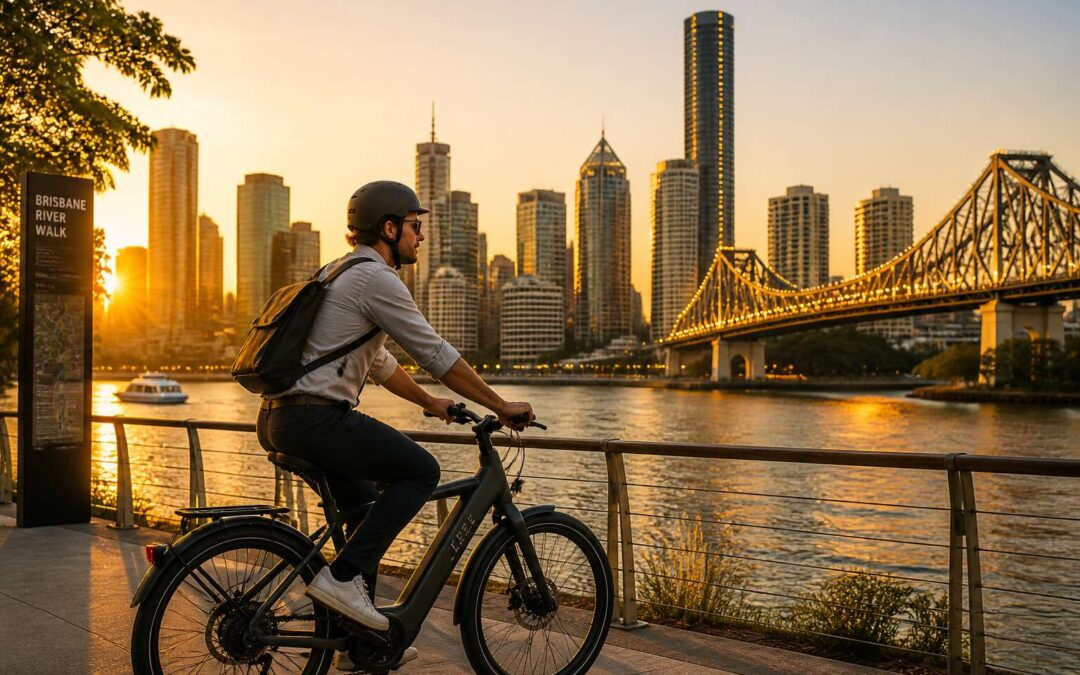
Why Brisbane Riders Are Switching to E-Bikes
Beating the Traffic Gridlock on the Gateway
Brisbane commuters lose around 74 hours a year to peak hour congestion, with the Gateway Motorway among the worst stretches. Sitting in that stationary queue, watching the bridge remain stubbornly distant, I know the arithmetic intimately.
The electric bicycle brisbane option changes the calculation. A rider on the dedicated bikeway parallel to the Gateway holds a steady 25 km/h while car traffic crawls at 12. My own trip from Wynnum to the CBD dropped from 55 minutes to 30!
- Car time across the Gateway at peak: 45 minutes
- E-bike time on the parallel path: 28 minutes
- Fuel and parking savings per year: over $2,500
I speak with fellow e-bike riders each morning. None of us plan to return to the stationary hours.
Overcoming the River City Hills Without Breaking a Sweat
Brisbane’s hills have long dictated who cycles. The city’s western ridges and inner north rises punish casual riders. But the electric bicycle brisbane movement is changing that equation. With a mid-drive motor, the climb from Paddington to Bardon becomes a gentle hum. I rode that route last week, arriving at the top without a single bead of sweat. My heart rate stayed calm. My shirt stayed dry.
Torque sensors on modern e-bikes respond to pedal pressure instantly. This makes the steep gradients of Highgate Hill and Teneriffe feel like rolling flats. Riders who once avoided cycling now commute daily.
Consider these notorious ascents that e-bikes have tamed:
- Caxton Street’s 12% grade
- The long drag up Kelvin Grove Road
- Wickham Terrace’s switchbacks
Each one used to be a barrier. Now they are simply part of the ride. The electric bicycle brisbane community grows because of this freedom. We are not athletes. We are people who want to enjoy the city without arriving exhausted.
Slashing Commute Costs Compared to Petrol and Public Transit
The average Brisbane commuter spends over $4,000 annually on fuel alone. That figure climbs higher when you factor in parking, tolls, and the relentless creep of public transit fares. Watching the fuel gauge dip after a week of inner city stop start traffic is a form of slow financial erosion. The electric bicycle brisbane commuter, however, has discovered a loophole in the city’s transport economics. A full charge costs cents, often less than a single bus ticket.
The charging cost is almost a rounding error. You will spend more on a coffee at the end of your ride than on the electricity that powered you there. Compare that to the monthly river of cash flowing into the tank or the Go Card. The shift from a petrol sedan to an electric bicycle brisbane model reallocates roughly $3,000 back into your pocket annually. That is a tangible return on investment.
Consider the difference:
– Petrol at $1.80 per litre for a 10km commute
– A Go Card daily peak fare for two zones
– Weekly parking fees in the CBD
– e-bike charging costs for the same distance
The choice is not about being eco conscious. It is about simple arithmetic. When your car sits idle for days because the e-bike handles the school run and the grocery trip, the savings compound. The motor vehicle becomes a weekend luxury, not a weekday necessity. This economic rationale is driving the quiet revolution. We are not swapping a car for a bike. We are swapping a leaky bucket for a sealed account.
Improving Personal Health Through Daily Low-Impact Exercise
Sitting diminishes physical capacity over time. Brisbane commuters who switch to an electric bicycle brisbane are not chasing athletic glory. They are restoring movement to a routine that modern work has stripped of it. The pedal assist reduces resistance, but the body still rotates, balances, and stabilises with every kilometre. This is exercise that fits into ordinary life.
The health benefits accumulate quietly:
- Sustained moderate heart rate without peak strain
- Joint friendly movement that avoids impact damage
- Muscular engagement in the legs, core, and back
- Improved circulation that counteracts prolonged desk sitting
Riders report better sleep, steadier moods, and a physical competence that fades with a sedentary existence. The electric bicycle brisbane does not demand sacrifice. It asks for ten minutes of effort and returns a body that feels capable again.
Reducing the City’s Carbon Footprint One Ride at a Time
Private cars are responsible for nearly sixty percent of Brisbane’s transport emissions, a figure that grows every time someone turns the key for a two minute milk run. An electric bicycle brisbane turns that lazy habit into an environmental asset. You still travel, but the combustion engine stays home.
Lifecycle analysis of e-bikes versus petrol vehicles shows a carbon footprint that is ninety eight percent smaller, even when charging from coal heavy grids. That is not greenwashing; that is basic arithmetic.
- Zero tailpipe emissions while riding
- Reduced demand for oil extraction and refining
- Fewer tyre particles from lighter, slower vehicles
Every kilometre on an electric bicycle brisbane quietly deletes a small amount of Brisbane’s carbon ledger.
Steering Clear of Expensive Inner-City Parking Fees
Charging $30 an hour for parking is a normal day in Brisbane’s CBD. That figure forces drivers to make absurd decisions, like moving the car every two hours or splitting a ticket with a colleague. An electric bicycle brisbane bypasses this entire ritual. No meters, no garages, no stress.
A quick comparison:
- Average daily inner-city parking: $45
- Monthly permit: $600
- E-bike charging for a month: $4
The cost difference is stark. Riders park within metres of their destination for free, using existing racks. They avoid feeding coins into a machine while late for a meeting. Every trip on this e-bike eliminates that fee entirely.
Exploring the Best E-Bike Routes Around the River City
The Riverside Loop: From South Bank to New Farm
With over 540 kilometres of dedicated bikeways winding through the city, Brisbane offers a unique perspective for those who choose an electric bicycle brisbane locals and visitors alike are beginning to embrace. The Riverside Loop is arguably the most scenic introduction to this network, a journey that begins amidst the cultural bustle of South Bank and stretches northwards toward the leafy enclaves of New Farm. Riding an e-bike here transforms the experience, allowing you to soak in the river’s glittering expanse without the fatigue of a long pedal.
The path itself is a study in contrasts. From the vibrant, artificial beach atmosphere near the Wheel of Brisbane, you quickly transition into the quiet shade of the river oaks. The gentle hum of your electric motor is the only sound competing with the lapping water. As you pass under the Story Bridge, the city’s iconic steel arch frames the sky above, a testament to the area’s industrial past meeting its modern, active present. This route provides a front-row seat to the city’s character, from the old wool stores of Teneriffe to the sleek new apartments that line the water’s edge.
Along the way, the journey breaks into distinct moments of urban discovery. You might pause to watch the CityCats glide past or observe the rowers training in the early morning stillness.
– The historical grandeur of New Farm Park’s fig trees
– The aroma of fresh coffee drifting from riverside cafés
– The sight of the CBD skyline reflecting off the water at sunset
These sensory markers make the ride more than just a commute. The electric assistance becomes particularly valuable when you navigate the gentle rises near the Howard Smith Wharves, where the path’s gradient can challenge even the fittest cyclist on a standard bike. With an electric bicycle brisbane riders find they can extend their exploration further, pushing towards the Powerhouse at New Farm without the mental calculation of whether they have enough energy left for the return trip.
The final stretch towards New Farm rewards you with the expansive green lawns and the fragrant rose gardens that define the area. It is a place where time slows down, and the city’s frenetic pace feels a world away. The loop back towards the city is a gentle, downhill glide, a well-earned reward after a day of exploration. It is in this moment, with the wind cooling your skin and the river sparkling beside you, that the true appeal of this modern mode of transport becomes undeniably clear.
Navigating the Bicentennial Bikeway and the Legacy Way
With 540 kilometres of dedicated pathways, the Bicentennial Bikeway remains a cornerstone for anyone on an electric bicycle Brisbane commuters rely on daily. This route hugs the river from the CBD west to Toowong, offering a smooth, almost level passage that showcases the waterway’s industrial edges and quiet bends. Riders pass beneath the Go Between Bridge, where the acoustic shadow of traffic overhead creates a curious sensation of being both in the city and removed from it. The path widens near the Regatta precinct, opening into a stretch where the river’s curves demand your attention, not your effort.
The Bicentennial Bikeway connects seamlessly to the Legacy Way tunnel corridor, which presents a different kind of challenge. This western artery requires a steeper approach, but the electric motor flattens the gradient, turning a punishing climb into a gentle ascent. The route rewards persistence with a sweeping view across the western suburbs, a panorama that few motorists ever glimpse. For those unfamiliar with the area, the signage is consistent and clear, though the occasional junction requires a moment of orientation.
– The Kingsford Smith Drive underpass, where the path dips below the road network
– The riverside boardwalks near Milton, which feature timber decking with a pleasing resonance under tyres
– The quiet residential stretches beyond Indooroopilly, where the bustle fades entirely
These sections offer distinct textures, from the polished concrete of the main corridor to the smoother, newly laid asphalt near the western end. An electric bicycle Brisbane rider will find the range sufficient for a full circuit, even with the additional effort of the Legacy Way incline. The return journey downhill provides a satisfying contrast, where regenerative braking on some models adds a subtle efficiency to the descent. The network’s design encourages longer rides, and the combination of riverside serenity with the elevated western outlook makes this loop a favourite among locals seeking both convenience and a sense of discovery.
Commuter Favourites for the CBD, Fortitude Valley, and Woolloongabba
The most intriguing part of commuting on an electric bicycle Brisbane riders discover is the way the inner city reveals its hidden connections. In the CBD, the grid of one-way streets forces a thoughtful route, but the dedicated cycle lanes along Margaret and Charlotte Streets turn the passage into a surprisingly rapid corridor. Fortitude Valley offers a different rhythm entirely, where the Brunswick Street approach demands alertness yet rewards with cafe-lined side streets that bypass the traffic choke points.
For Woolloongabba, the newly upgraded intersection at Stanley Street East provides a safe passage, though the connection through the Princess Alexandra Hospital grounds is equally useful. These three precincts form a triangle of commuter activity, each with distinct characteristics.
- CBD: fastest for direct trips, but watch for turning buses.
- Valley: more tactile, with varied surfaces and pedestrian interactions.
- Gabba: emerging infrastructure, quieter weekend rides.
The range of an electric bicycle Brisbane commute easily covers these zones, making the inner city a practical laboratory for daily mobility.
Hidden Gem Corridors for the Kangaroo Point and West End Network
Few riders bother with the river’s curve between Kangaroo Point and West End. They stick to the main bikeway and miss the corridor beneath the cliffs. On an electric bicycle Brisbane commuters can follow this route and see how these suburbs connect at the water’s edge. The stone face looms above. The boardwalk narrows. The Story Bridge appears without warning. I rode this stretch on a Sunday and felt the difference!
The corridor passes particular places:
- The cliff underpass, layered with decades of tags
- The Thames Street boardwalk, empty while the main path crowds
- Orleigh Park’s fig canopy at the West End end
These places sit between destinations. They hold a different quality of time. I now look for such corridors on every electric bicycle Brisbane ride.
Understanding the Planned Electric Bike Cross-City Links
Brisbane City Council’s 2031 transport plan calls for a 50 percent increase in cycling trips. That target depends on closing gaps between bikeways. On an electric bicycle Brisbane riders know these gaps intimately, dead ends, detours, waits.
Exploring the best e-bike routes around the river city shows what the planned cross-city links will solve. I have ridden the broken sections of the East-West Bikeway, and the difference is substantial. The North Brisbane Bikeway extension and Breakfast Creek Green Bridge address specific breaks.
- North Brisbane Bikeway connects Windsor to the CBD
- East-West Bikeway runs off-road from the west to the river
- Kangaroo Point Bridge extension ties the east and south networks
Understanding the planned electric bike cross-city links requires seeing the system as a whole. An electric bicycle Brisbane commuter crosses the city without repeating a section of path. The river loops, suburban spurs, and planned corridors connect.
Selecting a Perfect Electric Ride for Your Suburban Trips
Hub Motor vs. Mid-Drive for Climatic and Road Conditions
Brisbane’s humidity has a way of exposing a motor’s shortcomings. On a humid morning, a hub motor on the flats feels effortless, but tackle the Hamilton ascent and it whines under load. The mid-drive, by contrast, works through your gears, keeping the strain off the motor itself.
Road surfaces matter too. The smooth Bicentennial Bikeway suits hub motors, while rougher suburban streets favor the mid-drive’s lower center of gravity. For an electric bicycle brisbane resident would ride daily, the choice hinges on your routes.
- Hub motors handle flat, sealed paths with ease.
- Mid-drive excels on steep climbs and variable terrain.
- Brisbane’s heat affects both, but mid-drive runs cooler under load.
After testing both, I lean toward mid-drive for anyone crossing the Story Bridge or dodging storm drains in New Farm. Your electric bicycle brisbane should match the city’s climate, not just its map.
Battery Range Requirements for a Suburban to Outer-Suburb Journey
Most riders underestimate how far their daily loops actually stretch. Suburban errands in Brisbane rarely form a tidy out and back. School drop-offs, grocery runs, and detours to a friend’s place in Carina or Camp Hill can easily total 25 kilometres before lunch. An electric bicycle brisbane commuter buys for these trips needs a battery that handles the unexpected, not just the fastest line to work.
Battery range is the silent contract between you and the road. A 500Wh pack might claim 80 kilometres of assistance, but that figure assumes flat terrain and a featherweight rider. Brisbane’s western suburbs climb gently, then persistently. The drag from a loaded rear rack drains the cell faster than the marketing charts suggest.
– Regen braking helps on descents, but it only recovers a fraction of the energy used on the way up.
– Tyre pressure and tread compound affect rolling resistance more than most riders expect.
– Heat soak from the afternoon sun can reduce nominal capacity on older lithium cells.
For a journey from Kenmore to the CBD and back, I would not settle for anything under a 625Wh battery. That buffer turns a worrying battery gauge into a quiet reassurance. The outer-suburb run to Indooroopilly or Mount Gravatt demands even more headroom. Cut the advertised range by a third for a realistic estimate in this climate. A mid-drive motor, running through the gears, stretches those watts further than a hub unit at the same speed. Choose the larger battery when the frame allows it. The extra kilogram at the base of the seat post is a small price for the freedom to take the scenic route home.
Determining the Right Tyre Width, Terrain Ability, and Suspension Options
Brisbane’s suburban sprawl hides a fickle surface. One street is smooth asphalt; the next is a scarred track of roots and gravel. An electric bicycle brisbane rider who ignores tyre width will fight the handlebars daily. A 42mm tyre whispers over the Bicentennial’s sealed curves, but a 50mm offers the grip to disappear down a muddy fire trail by the river. The terrain chooses your tyres, not the colour chart.
Suspension adds another layer of negotiation. A stiff frame with a front fork suits the commuter who knows every dip in the bitumen. Full suspension saps battery through constant bounce, a waste on outward runs. For the unpredictable edges of Carina and Mount Gravatt, a lockable fork gives a firm ride on the road and a forgiving one off it. The right setup turns an electric bicycle brisbane journey from a jolting chore into a silent glide.
Looking for Weatherproofing and Corrosion Resistance in Humidity
Brisbane’s humidity does not negotiate. It seeps into brake levers, battery contacts, and every unpainted screw. An electric bicycle brisbane rider who ignores weatherproofing will spend more time drying out electronics than riding. Look for an IP65 rating. Sealed bearings and marine connectors matter more than a flashy display. The motor casing should be fully enclosed, and the battery mount needs a rubber gasket. Three components deserve scrutiny:
- Corrosion resistant chains with a nickel or zinc coating.
- Stainless steel spokes and nipples.
- Waterproof cable connectors with a locking collar.
Humidity also corrodes the frame. A powder coated aluminium frame survives far longer than bare steel. Check welds for complete paint coverage. The right suburban trip choice withstands the wet season without degradation.
Choosing Between Step-Through, Cargo, and Commuter Frame Styles
Frame geometry decides whether your electric bicycle brisbane feels like a natural extension of daily routine or a persistent source of friction. Step-through designs suit riders who make frequent stops at shops, schools, and cafes. You simply step off without snagging a trouser leg or shifting your weight awkwardly. Commuter frames lean into a forward posture, which helps on longer bikeway stretches where pace matters more than convenience.
Cargo frames carry what panniers cannot. They extend the wheelbase and lower the centre of gravity, keeping heavy loads planted. The right choice depends on what your suburban route demands:
- Step-through for quick, frequent stops
- Commuter for distance and steady speed
- Cargo for bulk and errand running
Test each style on the same route before committing. What feels stable in a showroom can feel entirely different on a suburban incline.
Understanding Brisbane’s E-Bike Laws and Safety Guidelines
Queensland Rules on the Maximum Power Output and Speed Limits
Queensland’s regulations impose a stark discipline upon every electric bicycle brisbane. The maximum power output is locked at 250 watts, a figure measured continuously, leaving no room for interpretation. Any motor exceeding this threshold transforms the machine into a different category entirely, one that demands registration and licensing.
Speed limits follow the same unforgiving logic. Assisted riding ceases at 25 kilometres per hour, and beyond that, you must rely solely on your own legs. The law does not care for the city’s hills or your schedule.
- 250W continuous power ceiling
- 25 km/h pedal assist cutoff
- Throttle only up to 6 km/h, if fitted
I have watched riders assume their purchase was legal, only to face fines. Familiarity with these rules is your sole safeguard when navigating Brisbane’s streets.
Clarifying When a Pedal Assist Bike Becomes a Motor Vehicle
No rider sets out to break vehicle registration laws. Every week, someone on an electric bicycle brisbane discovers that their machine has crossed a legal line. The moment a pedal assist bike exceeds Queensland’s technical definition, it ceases to be a bicycle. It becomes a motor vehicle, full stop. No warning lights flash. No paperwork arrives. The change is automatic. It carries obligations few expect.
Once that reclassification takes effect, the machine demands:
- Registration with the Department of Transport
- Compulsory third party insurance
- A valid motorcycle licence
Most riders learn this after being pulled over. I have seen it happen at roadside checks. Safety guidelines run parallel. Ride with traffic. Wear a helmet. Keep your bike visible. Treat every intersection as a place where a driver might not see you. Brisbane’s streets reward vigilance. That vigilance includes knowing exactly what your electric bicycle brisbane is in the eyes of the law.
Manoeuvring Through Pedestrian Zones, Public Paths, and Parkland
Brisbane’s network of pedestrian zones and parkland paths presents a different kind of challenge. These are spaces designed for leisure, not transport. The atmosphere shifts, the pace slows, and the rules tighten. An electric bicycle brisbane rider must understand where the machine is allowed to travel. Footpaths are generally off limits unless signage explicitly permits shared use. This is a frequent source of confusion.
The city’s planners have designated specific areas for mixed traffic. In these shared zones, speed becomes the primary concern. A pedestrian has the right of way. Your presence is a concession, not a guarantee. This is not the road. The margin for error is significantly smaller. A sudden move by a child or a dog can create a dangerous situation in an instant.
Consider the following when traversing these public spaces:
1. Slow to a walking pace when approaching blind corners or dense foliage.
2. Use a bell or verbal warning well before you are upon a pedestrian.
3. Dismount and walk the bike in the most congested areas, such as near picnic shelters or playgrounds.
Parkland paths present their own unique hazards. Uneven surfaces, tree roots, and scattered debris are common. A road-oriented electric bicycle brisbane may struggle on these surfaces. The onus is on the rider to remain alert and adapt. The penalty for a lapse in concentration is often a spill onto hard ground, or worse, a collision with a child. Respect these spaces for what they are, sanctuaries from the car. Your ride is secondary to the tranquillity of the environment. If you cannot maintain a safe and polite pace, you have no business being there.
Must-Know Helmet Standards and Safety Gear for a Sub-Tropical Climate
Queensland law requires every cyclist, including those on an electric bicycle brisbane, to wear an approved helmet meeting the AS/NZS 2063 standard. This is non-negotiable, even for a quick errand to the milk bar. The subtropical climate adds another layer: heat and humidity demand gear that breathes and protects without compromising focus.
- A lightweight, well-ventilated helmet with a snug, secure fit.
- UV-protective sunglasses or clear lenses for sudden downpours.
- Breathable gloves to manage sweat and maintain a firm grip.
- High-visibility clothing, especially for Brisbane’s infamous late afternoon storms.
Beyond legal requirements, practical choices reduce risk. A bell or horn is wise for shared paths, but know the local rules before relying on it. Regular checks of brakes and tyres are essential, as humidity can corrode cables and soften rubber. Your own preparedness matters as much as the machine’s compliance with power limits.
Demystifying the Insurance and Registration Expectations for Local Owners
Queensland’s legal framework for an electric bicycle brisbane is refreshingly pragmatic. A compliant e-bike, capped at 25km/h and 250W, requires no registration, no licence, and no compulsory third party insurance. That simplicity, however, can lead owners to overlook personal risk. I have seen riders assume their comprehensive car policy covers them. It does not.
Your private health cover may not respond to an e-bike crash the same way motor vehicle insurance would. Queensland law treats e-bikes as bicycles, so the rider carries the injury risk alone. Voluntary accident insurance is worth the premium.
- No registration or number plates for compliant models
- No licence required while power limits are respected
- Standard road rules apply, including signal and stop requirements
Modifying your machine beyond legal limits shifts it into motor vehicle territory. That shift brings registration duties and mandatory insurance. Keep the electric bicycle brisbane stock if you want to ride with legal certainty.
Maintaining Your E-Bike and Integrating into the Local Riding Culture
Crucial Battery Care Tips for Warm and Rainy Seasons
The subtropical heat of Brisbane demands a particular discipline from your battery. I have watched riders lose range by parking their electric bicycle brisbane commuters in the midday sun. Keep the cells between 20 and 80 percent charge when the mercury climbs! Rain creates a separate threat. Water ingress into charging ports is a known failure point.
Here is how I protect the drivetrain:
- Wipe the charge port dry before plugging in.
- Apply dielectric grease to the contacts.
- Store the battery indoors, not in a shed, during storm season.
Riding culture here values preparation. Locals respect someone who knows their machine. Join a morning group ride and you will learn the unspoken codes: signal early, share the path, and never leave a flat battery behind. These rituals make the electric bicycle brisbane lifestyle feel communal.
Protecting Braking Systems and Drivetrains from Dust and Corrosion
Brisbane’s dry westerly winds carry a fine dust that settles into brake callipers and chain links. For the electric bicycle brisbane rider, this abrasive layer accelerates wear faster than any climb. A weekly rinse and dry rag help, but the real trick is knowing where corrosion hides.
Salt from the bay breeze and storm humidity attack exposed metal. Brake rotors can rust within days if left wet. The drivetrain demands the same discipline. I use a dry lubricant that repels dust and wipe the chain after every damp ride. Local riding culture respects this diligence. When you join a group ride with clean brakes and a smooth-shifting drivetrain, others notice and offer their own maintenance tricks for this climate.
- Check brake pads for glazing after dusty rides.
- Inspect cable housings for corrosion near the levers.
- Clear grit from the derailleur pulleys.
Nobody wants a spongy brake lever at the next set of lights. Maintaining your machine earns quiet respect within the local riding culture.
Finding Dependable Repair Shops and Certified Technicians Nearby
In Brisbane, the difference between a good ride and a long walk is often the phone number of a certified technician. A dependable repair shop for your electric bicycle brisbane is a necessity after a season of dust and downpours.
Ask commuters on the Riverside Loop which workshop they trust. The best technicians stay booked for weeks. That wait list is a reliable review system. I learned this after a failed DIY attempt involving too much grease and misplaced confidence.
Join a Sunday ride and watch how locals maintain their machines. The rider who checks the motor connections before coffee is the one you follow. Their quiet diligence turns an electric bicycle brisbane from a purchase into a habit.
Joining Casual Group Rides, Meetups, and Community Inductees
Maintenance rituals shape your relationship with the machine. On any Sunday morning along the Brisbane River, you will see riders wiping chains and checking tire pressure before the first pedal. That diligence defines the electric bicycle brisbane riding culture.
Joining a casual group ride is the fastest induction. The pace teaches you how your bike behaves under real conditions. You learn which sounds are normal and which require attention.
- Check battery contacts after humid weeks
- Listen for drivetrain grinding on climbs
- Ask about routes with shaded rest stops
Newcomers are welcomed with shared knowledge of maintenance and paths. Each ride adds another layer of familiarity. The community turns routine upkeep into a collective habit.